
Christmas Is Like Dizzy--Part 1
If this article fails to display properly on your device, click here to read on my website.
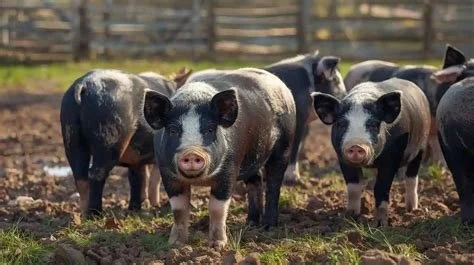
I used to work on a pig farm. Come to think about it, I had left home and gone to the far country of Kentucky, but for different reasons than the prodigal boy of Jesus’ story. Besides, I’m not at all certain he went to Kentucky. I think he actually wound up in Louisiana.
We were not a high tech swine operation by any stretch of the imagination. Nothing much was automated, excepted that we had to tend pigs every day, twice a day, and when a sow was about to deliver a litter of pigs we tended to her and hers all night. In pig parlance a sow’s gestation is “three months, three weeks, three days, three hours, and three in the morning.”
Raising pigs as we did was a hands-on operation. If you think about it, God gave a pig three handles with which to guide him: two ears and a rope-like tail. Moving pigs isn’t necessarily aided by a herd instinct like sheep or cows exhibit. But lift a hog by the tail and you can steer him like a wheelbarrow!
Winter was hard on our farm. You wouldn’t guess it, but pigs are sensitive creatures. Unlike cows and horses, sheep and goats, pigs don’t have a coat of fur to keep them warm. In fact, they don’t have fur at all; they have hair, and like mine, theirs is rather sparse.
So when the temperature dips and the ground gets hard, pigs pile up with one another to stay warm. This is a good plan for a cold night, unless you are the pig on the bottom of the heap.
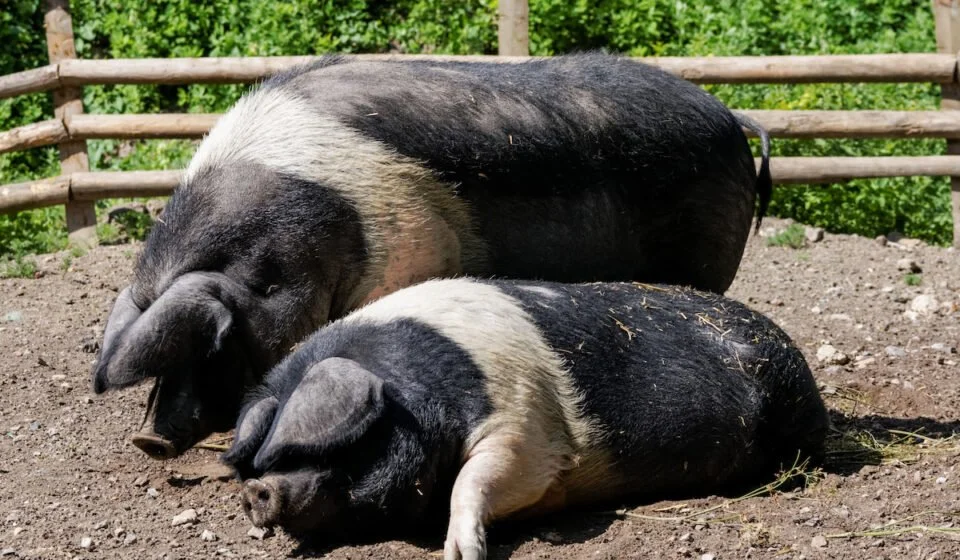
No matter how diligent our preparation, it was a long, cold walk from the dressing shack where we took off our farm clothes and put on our pig clothes, down the lane to the pig lot. One never knew what he would find.
If a pig was down—meaning he couldn’t get up—we had to remove him from the rest of the hogs or they would kill him and eat him. Truth be known, I really didn’t mind moving and working hogs, but dragging a dead or injured animal out of a feeding area into the barnyard was a dreary, messy task.
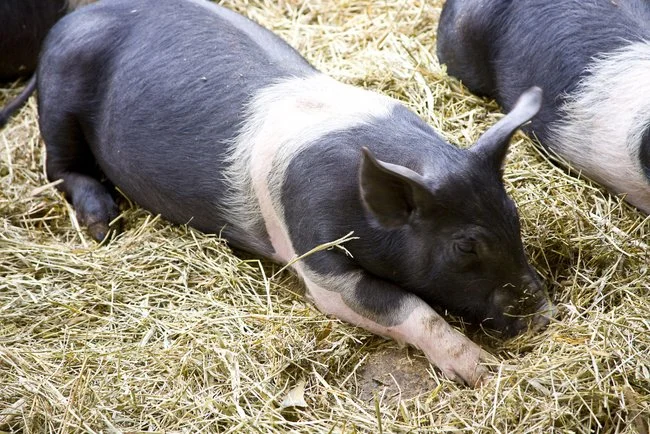
One cold morning we scraped our rubber boots along the frozen lane leading to the pig lot. Our first duty: checking the feeding floor for hogs that were down. Sure enough, one of our Hampshires was on his side. He was covered with defecation, partially chewed food, and the slime from pigs’ snouts. It took two of us to drag him from the feeding floor and into the barnyard.
The grim reality is that most farmers would simply dispatch this animal, and perhaps we should have that morning. We did leave him while we tended to the rest of the herd. An hour or so later, with our hands stuffed deep in our pockets and our stocking caps pulled down low on our foreheads, we stood over the injured hog contemplating our options: do him in or shoot him with some drugs and see if he makes it to the next feeding.
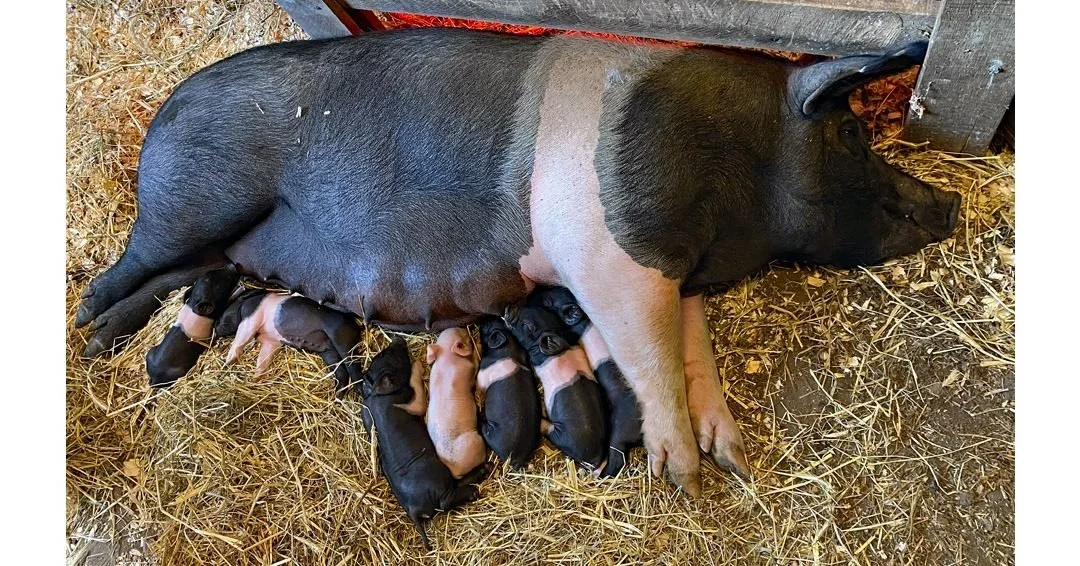
Ordinarily, there is an art to giving a pig a shot, but not with this pig. He simply lay against the out-building where we had dragged him and grunted slightly as we poked him two or three times with the needle and syringe. We left him lying in the sun and went about our chores.
Day by day, the pig lived. He didn’t go anywhere, but simply stood against the building in the barnyard. We fed him, and he ate. Watered him, and he drank. For a time he simply held his own in his fight to survive, but then he began to overtake his lot in life, started gaining weight, and looking better out of his eyes.
One spring day, the hog was not where he normally was. He had moved across the barnyard and was standing by a post grunting as he scratched his neck. His daily progress was reassuring that we had made the right decision not so long ago on that frigid morning.
For several days, we found the hog in different locations, so we knew he was moving about, but neither of us had actually seen him walk. This realization is only apparent now in retrospect. With 325 squealing swine snorting and rooting, it never crossed my mind to wonder how this one hog managed something as rudimentary as walking. It was simply enough to know that he was mobile, eating, drinking, and gaining on the goal of market weight.
But then with jaw-dropping amusement I observed one morning as the pig made his way from point “A” to point “B”. Evidently, while struggling under the pile of his pig brethren that harsh, winter night, the hog’s inner ear had been damaged. While he appeared healthy, growing, and mobile, he progressed toward his goal not in a straight line but in waltzing circles.
All of our pigs were simply identified by a number notched in their ears, but from that morning forward, this pig’s name was Dizzy. To look at him, he was simply another oinker in a lot full of hogs. Except that he had a name, and the reason for the moniker was readily apparent as soon as Dizzy moved any distance.
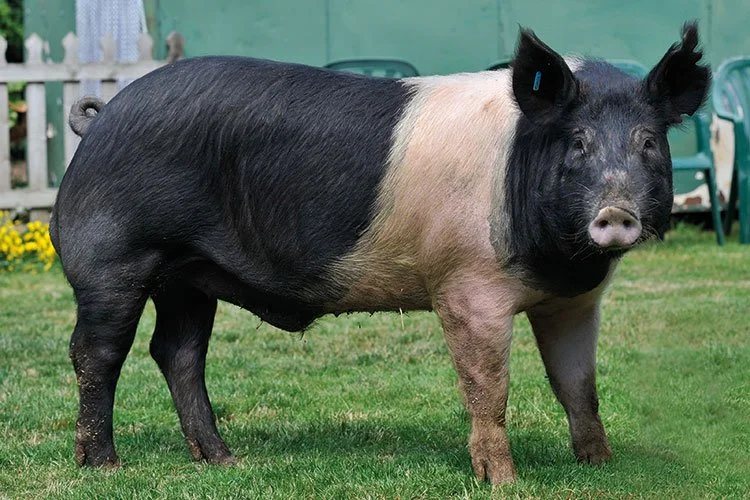
Like the color of our Hampshire hogs, life in the pig lot was black and white. If the ground was not frozen, it was muddy. In the winter, you had to keep the pigs dry. In the summer, they had to be wet.
I said we were not automated, but this is not entirely true. We had run water lines throughout most of our pens that were interspersed with drinking spigots. These worked when a hog rooted on them. This saved a great deal of water-hauling effort. However, pigs are incredibly destructive. Keeping the water lines working was a daily task. Something was always leaking, and this was partially by design.
When the weather heats up, pigs need help staying cool. In their minds, a mud hole is a gift from God, and I don’t know that I can argue their point. Submerging in the mud not only cools, but keeps the flies away from them, a point that was not lost on me as I shooed swarms of flies from me while the lounging swine observed from their disgusting wallows.
Mud holes just happened in the pig lot. I suppose from all the rooting and wallowing and natural low spots in the ground, we never once had to create a mud hole for the pigs. While they didn’t do anything else for themselves, I suppose a well-equipped mud hole was too important to be entrusted to a farmer. So, they made their own.
Because of his condition, Dizzy was not allowed in with the other pigs. While surrounded by those of his kind, he lived alone in the barnyard. Aside from a few puddles when it rained, Dizzy had no mud hole.
I never thought much beyond the simple things Dizzy needed, namely shelter, food, and water. Providing for his need to roll in the mud escaped my attention, so I never thought about it, until the day I missed Dizzy.
The cold of winter had given way to the heat of summer. Parkas and toboggans had been traded for overalls sans shirt, but still with the ubiquitous rubber boots. I was distributing corn from five-gallon buckets to the sows-to-be-bred when Dizzy’s absence registered in my mind.
I looked in the familiar places frequented by Dizzy, and began fearing the worst. I had often wondered if his progress was too good to be true. Chores were put on hold while we searched for Dizzy, but to no avail. We reconvened and contemplated what to do. Much as we had done the first morning considering the disheveled pig we would come to know as Dizzy, we stood with hands rammed deep into our overalls wondering what we should do and where he could be.
As we stood sweating in the sun, swatting at flies, it dawned upon us almost simultaneously, Dizzy was trying to escape the heat. He had gone to where he could coat his sensitive skin with protection from the very things plaguing us at that moment. He had gone in search of mud.
A feeding floor is simple enough in design. It is a sloping slab of cement where the manure and urine of many, many pigs, along with water from the sprinklers and any other detritus from the pig lot, slowly slides downward toward a cesspool. We had no fancy silo like the big boys have. No system to capture this semi-liquid muck and distribute it for fertilizer. We simply collected this waste in a great pond on the north side of the pig lot, and for good reason never went over there. It was a disgusting aspect of working with a large herd of animals in a relatively small space.
But this manure pond was the only wet place for Dizzy to retreat. As we thought about it, the feculent pond of refuse that we avoided like the plague was Dizzy’s only option to exercise his genetic disposition as a hog to roll in the mud and lounge in a wallow. Sure enough. We found Dizzy. The stench was gagging, and all was not well.
Dizzy had gotten into the muck easily enough, but when he attempted to get out, given that he walked in circles, Dizzy had literally screwed himself into the mud and manure and waste that had slid down the feeding floor for years. There, submerged to his shoulders in a greenish-brown ooze that seemed a good idea at the time, Dizzy was helplessly stuck from trying to get out of the mess he had wandered into.
I stepped into the repugnant morass in an effort to reach Dizzy, but quickly encountered two problems: First, Dizzy was screwed in deep, and second, he was in deeper than my boots were tall.
I backed out to my partner’s side where we again faced the same decision we had encountered months earlier: Do we dispatch him where he is—the wise and conscionable thing to do—or should we attempt to rescue him?
To be continued…